
Read more

Transparency International UK today published a detailed assessment of beneficial ownership registers in UK Overseas Territories, revealing that most major offshore financial centres have failed to deliver on transparency commitments made nearly seven years ago.
Opening-Up Offshore Secrecy evaluates progress by Bermuda, the British Virgin Islands, Cayman Islands and Montserrat against delivering corporate transparency through beneficial ownership registers.
This first tranche of assessments examines 92 criteria across two areas: the quality of each territory’s beneficial ownership framework and the accessibility of their register. Montserrat achieved an ‘A’ grade in both categories, making it the strongest performer in this first release. BVI and Bermuda both received an ‘F’ for accessibility of their register.
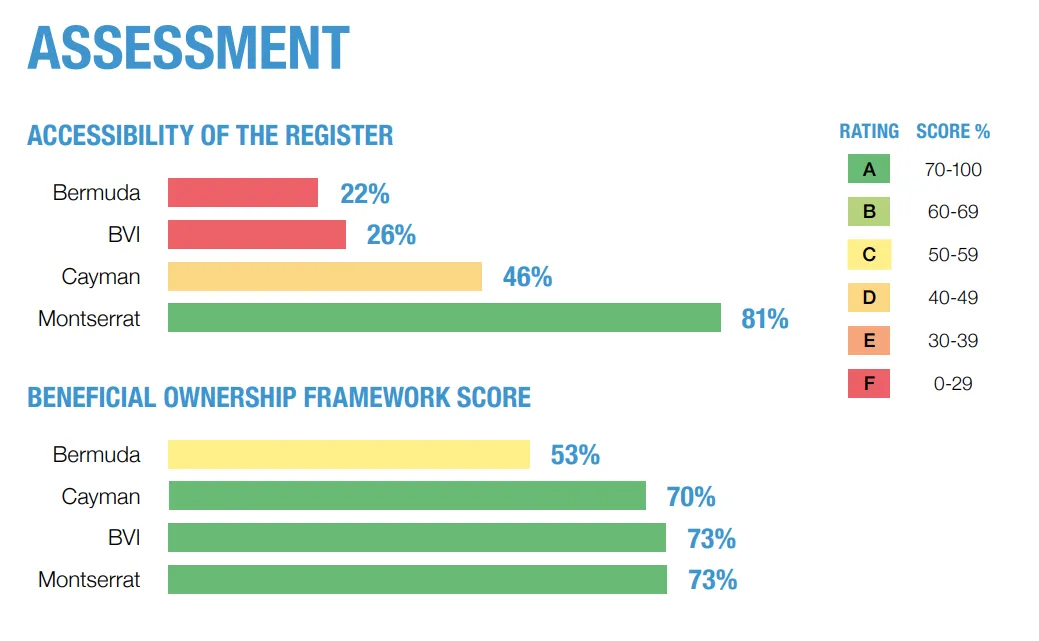
These ratings are based on a blueprint published earlier this year, designed to give Overseas Territories clear practical guidance to meet their transparency commitments and reveal the ultimate owners of companies registered there – whether through public or legitimate interest registers.
Margot Mollat, Senior Policy & Research Manager, Transparency International UK said:
“These results make one thing clear: behind the promise of progress, very little has changed. Company registries in Cayman, the British Virgin Islands and Bermuda largely remain closed, and these territories have fallen short of their promises made at previous Joint Ministerial Council meetings.
“A legitimate interest model still requires territories to be serious about transparency and should not serve as a cover for back-tracking on earlier commitments.
"Journalists, civil society groups and other investigators are essential to exposing wrongdoing. Continuing to deny them meaningful access sends a clear message: those territories still prioritise secrecy over wider transparency efforts to effectively tackle money laundering.
“When billions are looted and laundered through jurisdictions like the British Virgin Islands, communities worldwide pay the price - in schools, housing or hospitals in dire need of public funding. They face consequences, and so should the territories that fail to deliver promised reforms.”
Territories that have opted for an EU-style "legitimate interest" model rather than the public registers they originally committed to, could in theory still achieve the top grade, but in practice achieved much lower scores. This is mainly due to their narrow interpretation of the European model, and refusal to follow the EU guidance. These registers still limit the ability of journalists, civil society and law enforcement to combat money laundering.
Although the Crown Dependencies have recently committed to introducing legitimate interest registers, none are yet operational or accessible to the public, despite similar promises to deliver public registers more than seven years ago. Under this assessment, jurisdictions such as these, would be unlikely to score better than an F in respect to access to beneficial ownership data.
Key concerns include:
Only three territories – Gibraltar, Montserrat and St Helena – have established fully public registers, the most straightforward and cost-effective way of ensuring accessible, high-quality beneficial ownership data.
The assessment provides detailed scorecards and recommendations for each territory, along with case studies demonstrating how offshore secrecy has facilitated major corruption cases including the 1MDB scandal, the PrivatBank theft, and the Glencore Paradise Papers revelations.
Notes to editors:
Contact:
Jon Narcross, Senior Media and Communication Manager
[email protected]
+44 (0)20 3096 7695
+44 (0)79 6456 0340 (out of hours)