

Date of publication
18 November 2026
Reading Time
7 minutes 10 seconds
For almost two years, at 11.52 every morning, Serbians stopped what they were doing and stood in silence. The pause marked the minute in November 2024 when the concrete canopy at Novi Sad railway station collapsed, killing 16 people. The station had been rebuilt under a state contract worth more than $1bn – a contract whose costings remain secret.
The disaster became a byword for corruption. The student-led protests that followed were some of the biggest Serbia had ever seen, with hundreds of thousands of people taking to the streets under the slogan “Corruption kills”. On 25 October the party list that grew out of those protests won an outright majority in Serbia’s parliamentary elections – ending 14 years of rule by Aleksandar Vučić's Serbian Progressive Party.
Serbia is one of four countries where debates about corruption have featured in elections in the last few weeks. Brazil’s presidential runoff took place the same day and Israel’s parliamentary elections two days later. America went to the polls earlier this month. These elections all happened in very different contexts, but each came after leaders tested how far the rules would bend, and for whose benefit.
It’s tempting to see corruption as a side effect of that drift. However, the evidence points the other way. Liz David-Barrett, professor of governance and integrity at the University of Sussex and a Transparency International UK trustee, links democratic backsliding to ‘state-capture’ - leaders rewrite the rules in their own favour, steer public money and contracts to themselves and their allies, and dismantle the checks on their power – the courts, prosecutors, auditors and regulators. "Seen as individual acts, each step may be legal and defensible," she writes, "but in aggregate they constitute state capture."

In Israel we see what happens when those checks are targeted. Benjamin Netanyahu, who has led Israel for 19 of the past 30 years, has overseen a prolonged period of democratic backsliding. He is currently on trial for bribery, fraud and breach of trust – charges he denies. While the trial ran, his government voted to sack Gali Baharav-Miara, the attorney general overseeing it. Israel’s supreme court unanimously overturned the decision, prompting Justice Minister Yariv Levin and Communications Minister Shlomo Karhi to urge the government to defy the ruling. Netanyahu has asked for a pardon without admitting guilt, and his government passed a law, which comes into force after the election, handing politicians more control over judicial appointments. Last month neither bloc won a majority, and President Isaac Herzog has asked Gadi Eisenkot, not Netanyahu, to try to form a government.
In the US, the Trump administration has followed a similar pattern. In his first week back in office, Donald Trump fired 17 inspectors general, the officials whose job it is to find wrongdoing inside government. This was followed by a pause, by executive order, in the enforcement of America’s Foreign Corrupt Practices Act. A recent study found that on the day enforcement was paused, the share prices of companies with a history of bribery investigations rose significantly relative to other firms. Trump has also granted clemency to George Santos, a former congressman jailed for fraud, and to Changpeng Zhao, founder of the world’s largest crypto exchange, who had pleaded guilty to failing to stop money laundering on its platform. According to the Campaign Legal Center, a US watchdog, Zhao was pardoned after his company took steps that “enriched the Trump family by billions of dollars”. The V-Dem Institute says the US has lost its status as a liberal democracy for the first time in more than 50 years; only Hungary, Serbia and India have fallen further, and they took the best part of two decades to do it. Most recently Americans handed control of both the House and the Senate to the Democrats, in an election the Associated Press said was driven by frustration over high prices, the Iran war and concerns over corruption.
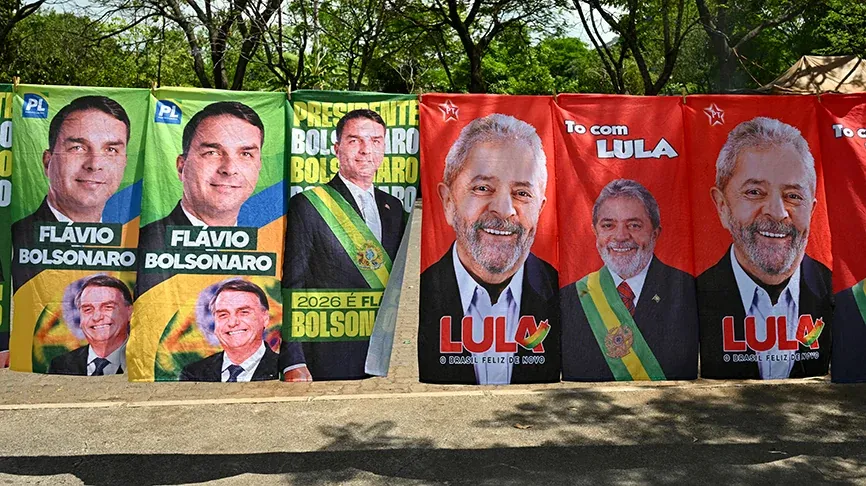
Brazil shows what happens when scandal is never matched by reform. Its institutions passed one test: the courts convicted Jair Bolsonaro of plotting a coup, and when his son Flávio narrowly lost last month’s runoff to Lula, even his own party accepted the count. Yet a decade of corruption cases, from the Car Wash investigations to the collapse of Banco Master, has touched politicians on every side without changing the system that produced them. Flávio Bolsonaro is under investigation over money sought from the bank’s owner, which he denies; Lula’s son is being investigated over a pensions fraud. Polling found more voters blamed the left for the bank scandal than the right, even though the documented links run mainly to the right. When every party looks dirty, people stop believing anyone can clean things up, and anti-system politicians thrive on that collective lack of trust.
The good news is that voters will punish corruption when they can see how it works. In April Hungarians gave Péter Magyar’s Tisza party a two-thirds majority on a turnout of almost 80%, after he promised to dismantle the “industrial-scale corruption” of the Orbán years. In Serbia the ruling party’s vote held up; it lost because people who had given up on voting came back. In both countries the demand was specific. The Serbian students first asked simply to see the Novi Sad contracts, and their programme now promises to publish every state contract and tender. People will back clean politics when it comes with concrete rules attached. But, as David-Barrett warns, capture, once established, is “not easy to roll back” – far better to build the defences before they are needed.
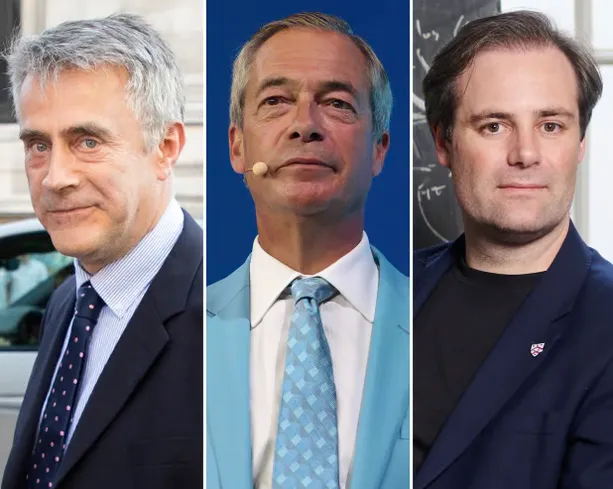
Britain is neither Hungary nor Serbia, but it is not immune. The UK recorded its lowest ever score on Transparency International’s Corruption Perceptions Index this year, and V-Dem lists it among countries where democratic quality is measurably falling. Ipsos found just 9% of people trust politicians to tell the truth, the joint-lowest figure since it began asking in 1983. This should come as no surprise. Our own research found that under Boris Johnson’s government, £15.3bn of Covid contracts carried three or more corruption red flags with £4.1bn going to people with known political connections – almost one in every ten pounds spent on the pandemic response. Keir Starmer sent Peter Mandelson to Washington despite his known friendship with Jeffrey Epstein; police are now investigating claims that Mandelson passed market-sensitive government information to Epstein. In September two crypto billionaires gave Reform UK a reported £36m each, the largest donations in British political history. One of them, Ben Delo - among the crypto executives Trump pardoned last year - reportedly paid upfront before a cap could be introduced. In each case, any safeguards depended on people choosing to behave well.
That is Britain’s particular weakness - so much of its democracy rests on convention rather than law. For too long Britain has relied on the outdated “good chaps” theory of government – ministers follow the code because they choose to, and watchdogs advise but cannot act. Convention can be ignored quietly; statute has to be repealed in public. The Representation of the People Bill, now in the Lords, already suspends crypto donations and caps donations from voters living overseas. But a decade ago million-pound donations made up about 1% of private donations to British parties; now they account for more than a third. Peers should finish the job with a cap on all donations and a permanent ban on crypto donations. The new Ethics and Integrity Commission should be written into law, with the power to investigate, making it harder to dismantle, and the Hillsborough Law should reach the statute book with its new offence of corruption in public office. Andy Burnham promised to end “broken politics-as-usual”. Integrity is infrastructure, and this would be how he builds it.
None of this requires a crisis to justify it. A cap on donations would stop any one person buying outsized influence. A statutory ethics watchdog with the power to investigate would stop ministers marking their own homework. A criminal offence of corruption in public office would mean real consequences for those who abuse it. The means to do most of it already exist. The students of Serbia began by asking to see the contracts; Britain’s leaders should act before it has to ask the same question.
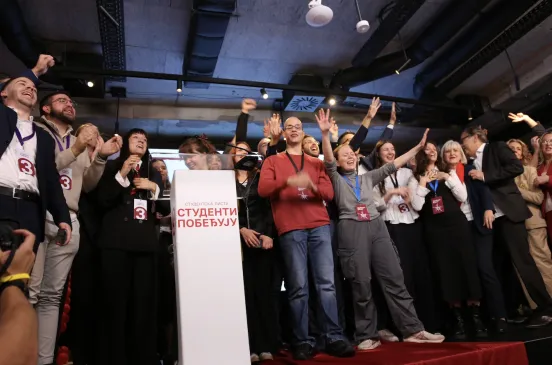
Student List candidates celebrate victory in Serbia's election