
Date of publication
16 February 2026
Reading Time
4 minutes 10 seconds
As police investigate potential criminal wrongdoing by former UK minister Peter Mandelson, we reflect: Without the US Justice Department releasing thousands of Jeffrey Epstein’s personal emails, would we have ever known that a UK government minister tried to ‘amend’ government policy after discussions with a foreign businessman and sex offender? And could this sort of behaviour be hidden today?
What the emails show
The released emails between Peter Mandelson and Jeffrey Epstein reveal an uncomfortably close relationship, where the boundaries between policymaker and businessman had effectively collapsed. In one exchange, Mandelson described trying to “amend” a government decision after Epstein lobbied him to curtail changes to bankers’ bonuses – a policy introduced following the 2008 financial crisis in response to widespread public anger. Later emails show Mandelson advising Epstein and his JP Morgan associates to “mildly threaten” the then Chancellor, Alistair Darling to abandon the policy. Darling’s autobiography and subsequent BBC reporting confirm that senior bankers did subject him to intense lobbying to do exactly that.
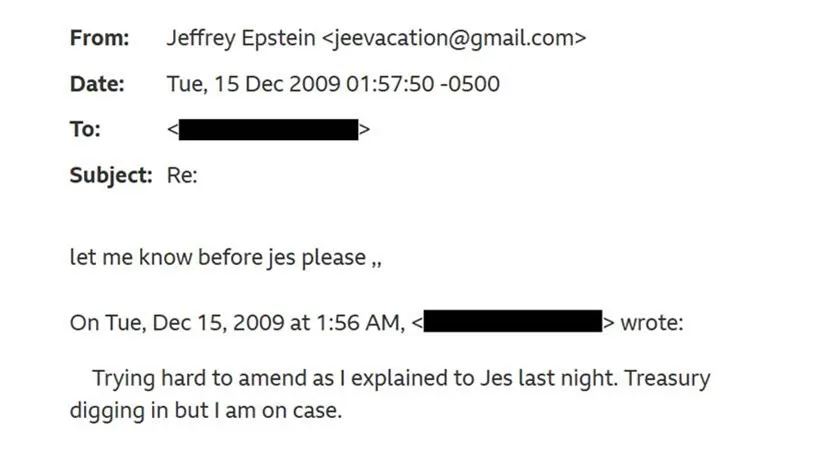
The policy to curtail bankers’ bonuses was a direct response to public outcry and economic crisis. It ran against the interests of the banking community, including Epstein and his networks. Yet the emails show Mandelson acting in ways that appear to favour those banking interests. That this activity occurred at all is extremely troubling. That it would almost certainly have remained hidden without a US federal investigation into Epstein’s crimes is in some ways worse.
Mandelson has told the BBC that every UK and international bank was making the same argument about the impact on UK financial services, stating "My conversations in government at the time reflected the views of the sector as a whole not a single individual," But this defence actually reinforces the case for transparency – without a comprehensive record of who lobbied whom, on what and through which channels, the public has no way of verifying such claims or understanding how policy decisions like these are shaped.
We know Epstein evaded accountability for serious sexual offences for years. The connections between this abuse of power, his wealth and his extensive networks cannot be separated from the lobbying story. Where elite networks operate without oversight, and misconduct faces no real consequences, multiple forms of exploitation - including sexual violence - continue with impunity. Accountability gaps don't exist in isolation.
A broken system
Even former Prime Minister Gordon Brown has responded to these revelations by calling for a crackdown on “the systematic abuse of power by lobbyists” and demanded action on lobbying reform. When someone who has been that close to the centre of political power is sounding the alarm, it should not be ignored.
Unfortunately, even after countless lobbying scandals, Westminster’s lobbying transparency system remains woefully opaque, with access to decision makers often happening behind closed doors.
Two datasets supposedly reveal the full picture of lobbying, but both fall short.
The first is departmental transparency releases but these only capture face-to-face meetings and occasional calls. Lobbying conducted via email - or, as is increasingly common, via Whatsapp or other messaging apps – goes entirely unrecorded.
The second is the Register of Consultant Lobbyists, which according to Chartered Institute of Public Relations contains only 283 entries - compared to thousands on the equivalent registers in Canada and Scotland. This stark gap exists because the UK’s lobbying register doesn’t include in-house lobbyists: the professional lobbyists employed directly by companies, trade bodies and other organisations. Transparency International UK’s own analysis estimates that as a result, the register captures as little as 4% of active lobbyists.
But the exclusions go further still. Loopholes such as a ‘VAT exemption’ which allows smaller lobbying operations to avoid the register entirely. These, outlined, gaps mean several high-profile lobbyists being left off the register entirely. Among them: Mandelson’s own lobbying company Global Counsel and former Prime Minister David Cameron for his work with Greensill Capital.
Why this matters
Lobbying transparency is not a universal cure, and it works best alongside strong enforcement. But analysis shows strong transparency of lobbying activity can reduce undue influence, improve democratic accountability and bolster the legitimacy and fairness of policy decisions. This is possible through the deterrent effects of transparency and increased public scrutiny and the simple fact that knowing your interactions with decision-makers are on the record.
What needs to change
Labour now has an opportunity to introduce meaningful reform and respond to the public's concern over the rich’s influence on politics. The government should introduce a comprehensive lobbying register that:
- covers both consultant and in-house lobbyists closing the gap that leaves 96% of lobbying activity unrecorded
- requires registration of the specific policy areas and bills being lobbied on so the public can see not just who is lobbying but what they are trying to achieve
- captures all relevant forms of communication - face-to-face, telephone, email, messaging apps – reflecting how lobbying actually works in the modern day
It should be a register of lobbying activity, not just ‘consultant lobbyists’. Countries like Scotland, Canada and Germany demonstrate a better lobbying transparency system is possible. All three include in-house lobbyists and the latter two also require that lobbyists register their policy aims, and legislation they are seeking to influence.
Had such a system been in place, anyone lobbying Mandelson would have been required to register. And Alistair Darling, or whomever may be put in this position in the future, might have been able to trace the lobbying campaign he was subjected to and make a better-informed decision.It should not take a US federal investigation into a convicted sex offender to reveal how UK government policy is being shaped behind closed doors. Without this reform, the next potential Mandelson-Epstein scandal could remain hidden. The public deserves to know who influences their government, how and why.