

Researchers
Stephen Abbott Pugh Date of publication
23 November 2026
Reading Time
26 minutes 30 seconds
Download
Document
Opening up Offshore Secrecy II
(4.43 MB)
Introduction
Companies and trusts are known to be key enablers of money laundering and a range of connected crimes, including corruption, fraud, human trafficking, and sanctions evasion. The secrecy offered by jurisdictions, like the Crown Dependencies, has provided cover for those seeking to extract ill-gotten gains and move them throughout the global economy. While the scale of illicit wealth flowing through their shores is hard to calculate, it is likely substantial.
Despite journalists and civil society organisations playing a key role in exposing and tackling criminality, their access to information about who owns companies incorporated in these isles remains limited to leaks and what is on UK corporate filings.
To their credit, the Crown Dependencies have recognised the need to broaden who can see this data, yet progress to date has been painfully slow. In 2016, they agreed to improve information exchange with UK law enforcement authorities.
This paper provides a stock-take of progress by the Crown Dependencies towards widening access to beneficial ownership information, and identifies where there is room for improvement. It follows an equivalent assessment in 2025, which covered a selection of Overseas Territories.
This is a rigorous review of the laws, regulations, policies, and procedures in these jurisdictions using our good practice guidelines, synthesised from global standards and experience from the UK and EU.
From this process, we have developed several recommendations for improvement. Some of these are cross-cutting and apply to all of the Crown Dependencies (see Recommendations section). Others are jurisdiction-specific, and are covered in the section for each of the Dependencies. Given successive delays in progressing beneficial ownership disclosure in these islands, all should be implemented as a matter of priority.
Assessment
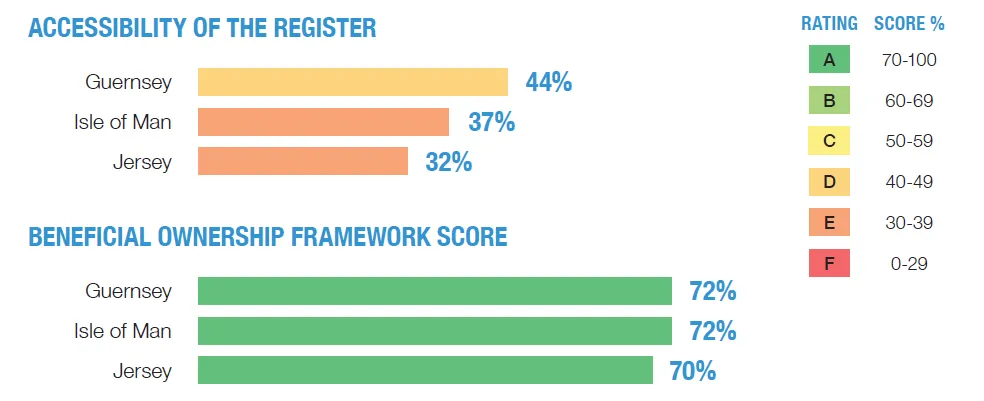
Key findings
The Crown Dependencies have taken similar positions on beneficial ownership disclosure. Consequently, there are common timelines, strengths, and weaknesses in their approach.
Progress is slow: Despite committing to the UK to introduce public registers, and then pledging to follow the EU’s approach, none of the Crown Dependencies managed to introduce legitimate interest access by the 10 July 2026 deadline for EU member states.
Not yet in force: The Crown Dependencies have consulted on how to disclose beneficial ownership information to those with a legitimate interest. However, questions about timelines for implementation, who can access data and how, costs, and application processes remain unanswered.
Key strengths
Definitions: Beneficial ownership definitions either largely or fully follow international guidelines.
Privileged access: Domestic competent authorities and regulated businesses have access to beneficial ownership information.
Enforcement: There is a broad suite of proportionate enforcement powers, which have the potential to provide a robust and credible deterrent against non-compliance with beneficial ownership disclosure laws.
Key weaknesses
More restrictive than the EU: They propose to allow only journalists and civil society organisations engaged in preventing money laundering, and digital Know Your Customer businesses, to submit access requests, which will be considered on a case-by-case basis. Preventing or investigating predicate offences does not appear to be considered a legitimate reason for an application. This frames access rights more narrowly than the EU’s sixth anti-money laundering directive (AMLD6), which sets out 11 categories of legitimate interest users, including foreign competent authorities and company registrars; grants general registry access to journalists and civil society; and considers tackling predicate offences a legitimate purpose.
No access for individuals with a legitimate interest: Members of the public will not be able to request access, even if they are involved in investigating money laundering or a predicate offence, which again frames access rights more narrowly than AMLD6.
Financial sanctions risk: All the Crown Dependencies check whether individuals or entities on their registers are subject to economic sanctions, but they do not flag sanctioned individuals or entities to registry users.
Risk to applicants: Beneficial owners or their representatives will be able to request personal information on those accessing their data. Only Guernsey has confirmed it will not disclose data on applicants under subject access requests, because it would undermine efforts to tackle financial crime.
Missing data: Disclosable information will not include the dates on which a beneficial owner was notified/became a beneficial owner; dates when information was last updated; or historical beneficial owners, making it impossible to identify who owned or controlled an entity at a given time.
Exemptions from disclosure: None of the Crown Dependencies currently plan to publish statistics on the number of beneficial owners who have successfully applied to have their information withheld from disclosure. There is also no process planned for applicants to object to exemptions; for example, where an applicant has clear evidence showing that disclosure would be in the public interest.
Costs and process: Currently, there is little clarity about how the Crown Dependencies will manage the process for applications, and what costs they might charge users.
Recommendations
The UK Government should:
- Redouble efforts to work with the Crown Dependencies to implement ‘broad and inclusive’ legitimate interest access
- Work with the EU to create strong incentives for the Crown Dependencies to improve how they provide legitimate interest access to beneficial ownership data, such as including AMLD6 standards in the assessment criteria for the Code of Conduct (Business Taxation) Group.
- Work with the Crown Dependencies to explore a joint platform for disclosing beneficial ownership data to those with a legitimate interest to reduce duplication, share the costs of delivery, and help avoid legacy IT systems being a blocker for further policy and legislative change.
The Crown Dependencies should:
- Reaffirm commitments to public registers as the ultimate objective. They play a vital role in promoting economic growth, safeguarding financial integrity and protecting the UK’s global reputation as a safe and sustainable business environment.
- When pursuing legitimate interest access to beneficial ownership registers, follow approaches in the EU and elsewhere that provide the maximum possible access to users, rather than engaging in a race to the bottom. As a first step, this should include unfettered access to UK and EU law enforcement agencies and competent authorities (such as anti-money laundering supervisors).
- Flag to users where individuals or entities on the register are designated for economic sanctions.
- Ensure beneficial owners and their agents cannot access any information about the identity of applicants through subject access requests, or details that might tip them off that they are under investigation.
- Disclose dates on changes to beneficial owners and historical data, so investigators can understand who owned or controlled a company at any particular point in time.
- Ensure costs for accessing data are reasonable, not prohibitive and limited to what is strictly necessary to cover the costs of ensuring the quality of the information held on the registers and making the information available. The process should also be lightweight and seamless for legitimate users.
Progress Update
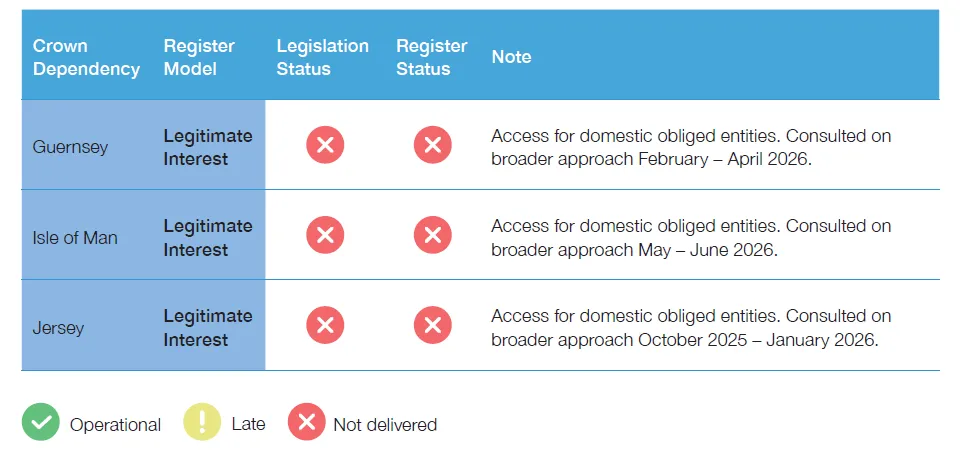
Guernsey
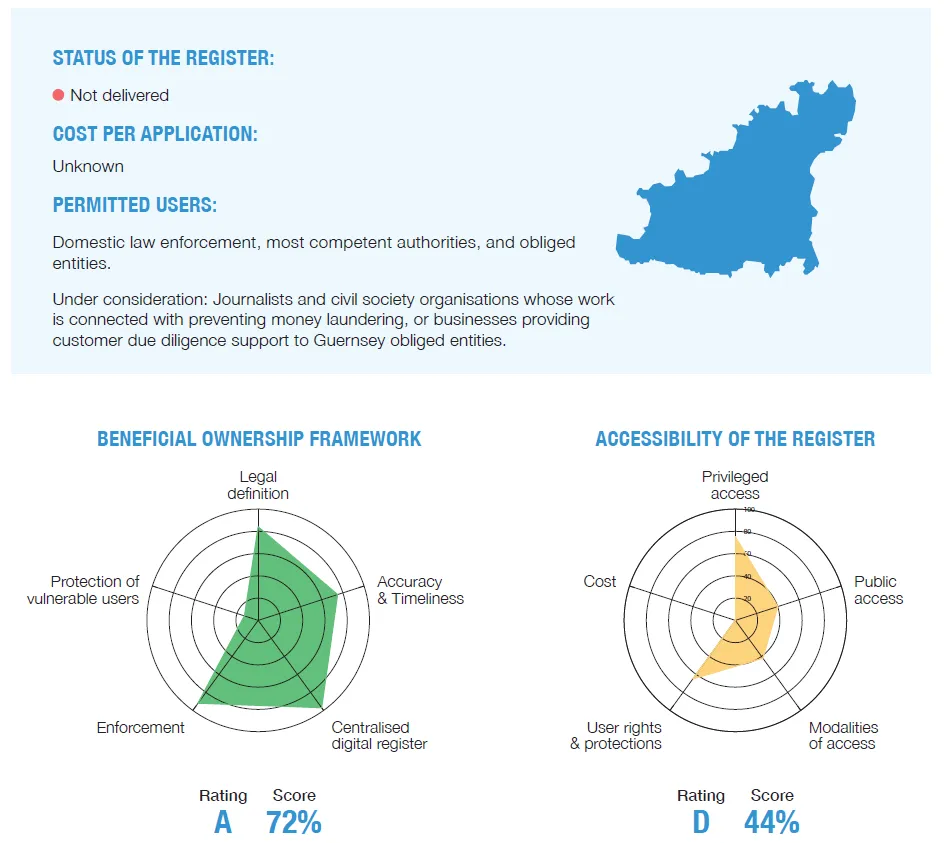
Background
The Bailiwick of Guernsey comprises the islands of Guernsey, Alderney, Sark, Herm, Jethou, Brecqhou and Lihou, which are home to almost 65,000 residents.
Financial services covering banking, insurance, investment, the provision of trust and corporate services and online gambling account for around 40 per cent of local economic activity.
Guernsey’s national risk assessment for money laundering notes that ‘unlike some other [international finance centres] Guernsey is not a major incorporation centre.’
Risks and vulnerabilities
Key risks
The use of complex corporate structures involving Guernsey entities to launder the proceeds of foreign criminality with underlying offences most likely including corruption, fraud, tax evasion, and drug trafficking.
The highest risk sectors for money laundering are private banking and trust and company service providers (TCSPs).
Vulnerabilities
Money laundering investigations and prosecutions are rare, law enforcement agencies are under-resourced, and criminal penalties are insufficient to provide a credible deterrent and largely targeted at lower-risk domestic activity.
There is also room for improving its supervision of firms, use of intelligence, and use of confiscation powers to deprive criminals of their ill-gotten gains.
FATF status
Guernsey is largely compliant with FATF recommendation 24 and compliant with recommendation 25.
Overall, it is compliant or largely compliant with all 40 FATF recommendations. It is ‘substantially effective’ in terms of FATF’s immediate outcome 5 relating to legal persons and arrangements.
Guernsey has consulted on proposed changes to address recommended actions.
Key strengths
Law enforcement access: Guernsey are to provide UK law enforcement with direct access to their beneficial ownership register.
Beneficial ownership reporting obligations: Apply to companies, their owners, and TCSPs. Every company must have a registered agent resident in Guernsey to oversee its activity.
Cross-checking of information: Beneficial owners are issued with unique identifiers to surface where they have links with multiple companies, and a range of measures have been introduced with the aim of keeping beneficial ownership filings up to date.
Key weaknesses
Location of applicants: Proposing to limit legitimate interest applications to those from the UK and Crown Dependencies.
Discrepancy reporting: Competent authorities with direct access to full beneficial ownership information can submit discrepancy reports where they spot errors, but are not obliged to do so.
Protection of beneficial owners: Guernsey is yet to provide detail about the mechanics for protecting beneficial ownership information, including the evidence required to support an application for exemption from disclosure; the timeframes for processing applications; and transparency about the use of exemptions.
Exemption reporting: Where legal entities are exempt from beneficial ownership disclosures, they do not have to state the basis of their exemption.
Case study: The Hajiyevs’ unexplained wealth and Trident Trust Company (Guernsey) Ltd
In April 2018, the National Crime Agency secured property freezing orders against several assets worth over £21.5 million that, according to the land registry, were held by Natura Limited, a company incorporated in Guernsey. This formed part of a wider civil recovery investigation into over £30 million of UK property connected to Jehangir Hajiyev, the former Chair of the International Bank of Azerbaijan, convicted in Azerbaijan in October 2016 for embezzlement. Investigators alleged that the properties were bought with unexplained wealth, likely the proceeds of crime, and later secured a settlement with Mr Hajiyev’s wife, Zamira Hajiyeva, worth tens of millions of pounds. The Hajiyevs’ lawyers claimed information potentially crucial to the case was held by Mr Hajiyev, but that the authorities in Azerbaijan denied Mrs Hajiyeva and her lawyers access to him in prison.
Trident Trust Company (Guernsey) Ltd was Natura’s registered agent from its incorporation in August 2013 until February 2017, when it resigned from providing services to the company. In September 2013, Natura acquired UK properties for the Hajiyevs in what the NCA called ‘…a highly unusual, secretive and complex manner which, absent further and credible explanation, is indicative of money laundering.’ Following Trident’s resignation in February 2017, Natura’s administration passed to another business, and was subsequently struck off Guernsey’s corporate register in May 2017.
The involvement of complex secretive structures to buy UK property, and Mr Hajiyev – a senior public official from a country with significant corruption challenges – should have given Trident reason not to proceed with this business relationship.
Trident was not sanctioned following the NCA’s enquiries or accused of any wrongdoing. However, subsequent regulatory action by the Guernsey Financial Services Commission (GFSC) shows the Hajiyevs were not the only questionable clients Trident represented.
In July 2024, the GFSC sanctioned Trident and three of its staff for serious anti-money laundering failures spanning a significant period. Structures they managed received funds from an ultimate beneficiary linked with allegations of money laundering, corruption, insider trading, bribery, forgery, and links to organised crime. The firm had also inadvertently provided inaccurate and misleading information to Guernsey banks about the true source of funds for transactions. The real ultimate beneficiaries of these transactions included an individual operating in a high-risk natural resource industry, and later subject to criminal investigation for corruption, as well as someone linked to an investigation into suspected fraud, bribery, and corruption, and alleged to have paid bribes to secure mining licences in a high-risk jurisdiction. The GFSC said all three staff showed a serious lack of ‘competence, soundness of judgement and diligence.’
When approached for comment, a spokesperson for Trident said that the 2024 enforcement action related to historic matters that have been fully remediated. They stated the company is fully committed to complying with all relevant laws and regulations, including anti-money laundering requirements, and proactively inform relevant authorities where any compliance processes gives rise to concerns. Where Trident clients do not meet regulatory standards they will try and bring them into compliance, and terminate the business relationship if this is not possible
How Guernsey can improve its beneficial ownership framework and accessibility
- Location of applicants: Do not limit access rights to only those from particular jurisdictions. In a world in which financial crime is increasingly globalised, it makes little sense for the response to be regionalised and siloed.
- Discrepancy reporting: Guernsey has an opportunity to strengthen the accuracy of its beneficial ownership data by moving discrepancy reporting by competent authorities from policy into a legal requirement.
- Protection of beneficial owners: Guernsey should provide more details about how it intends to protect vulnerable beneficial owners’ data, including the process for applications and appeals.
- Exemption reporting: Guernsey should require legal entities exempt from beneficial ownership reporting requirements to confirm the basis of their exemption to the registrar.
Isle of Man
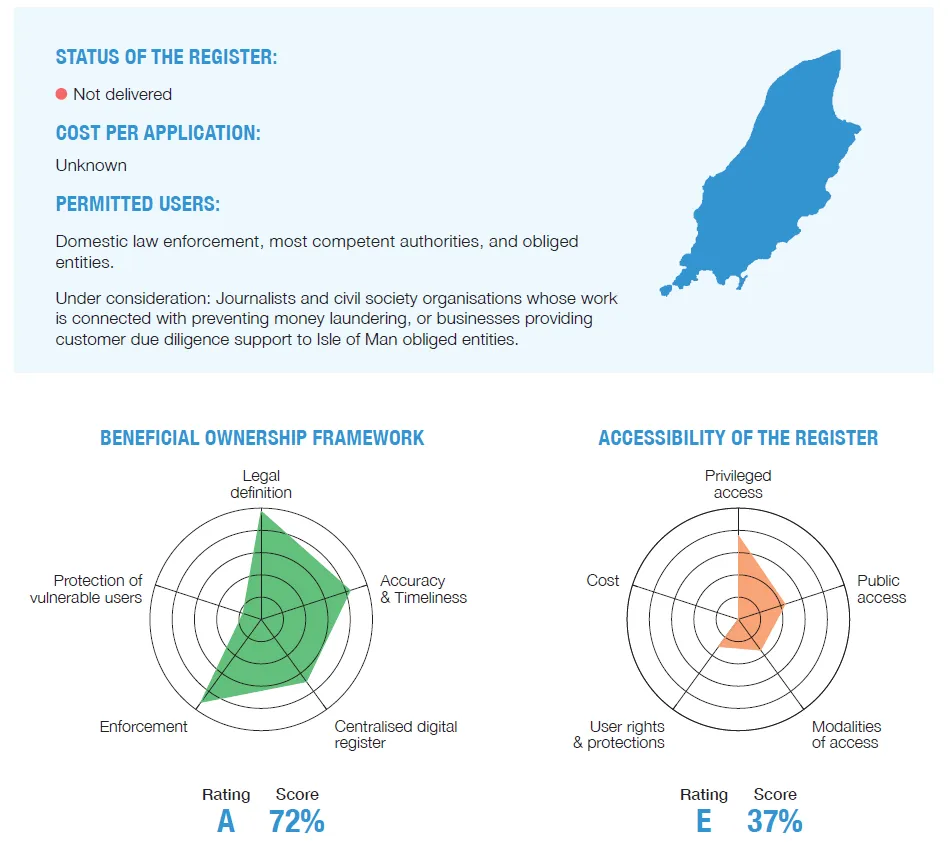
Background
The Isle of Man houses what is considered the world’s oldest continuous parliamentary assembly,
Located in the middle of the Irish Sea, it is home to around 84,000 residents
Just under half (45.7 per cent) of reported beneficial owners reside outside of the Isle of Man.
With zero corporate tax on most activities, Isle of Man companies often feature in complex international business structures linked to suspected corruption, drug trafficking, fraud and tax evasion cases, as well as being used to hold UK property.
Key risks and vulnerabilities
Key risks
Complex, multi-jurisdictional structures – such as those often seen in the online gambling sector
The highest risk sectors for money laundering are banking, online gambling, and TCSPs.
Vulnerabilities
Historically, there have been serious questions about the performance of its financial intelligence unit, law enforcement action against money laundering, and the use of confiscation powers.
FATF status
The latest enhanced follow-up report, in 2022, found that the Isle of Man was largely compliant with recommendation 24 and compliant with recommendation 25.
Key strengths
Verification powers: Once it is granted Royal Assent, the Isle of Man’s Verification of Entity Registration Bill 2026 will give its registrar strong powers to verify and cross-check beneficial ownership filings, driving up the quality of information.
Shared responsibility for data quality: Legal entities, nominated officers and beneficial owners all take responsibility for making sure beneficial ownership information is accurate and up to date – with sanctions for those who fail to comply.
Key weaknesses
Location of applicants: Considering plans to limit legitimate interest applications to those from a particular jurisdiction or region.
Discrepancy reporting: Competent authorities with direct access to full beneficial ownership information are not legally required to submit discrepancy reports where they spot errors.
Protection of beneficial owners: The Isle of Man is yet to provide detail about the mechanics for protecting beneficial ownership information, including the evidence required to support an application for exemption from disclosure; the timeframes for processing applications; and transparency about the use of exemptions.
Case study: Bangladesh
In August 2024, a popular uprising in Bangladesh ousted the increasingly authoritarian regime of Sheikh Hasina and the Awami League. Following her fall from power, one of the first priorities of the interim government was to recover billions of pounds allegedly stolen during her 16-year rule. Even before the 2024 revolution, local media outlets had reported that key Hasina insiders had used the UK as a destination for their ill-gotten gains, which prompted us to start investigating.
Using filings from UK Companies House, land records, and local knowledge from Bangladesh, we were able to identify 400 properties across England valued at over £460 million, bought by those alleged to have profited from corruption during Sheikh Hasina’s reign.7 To date, at least £260 million of these properties have been frozen pending further investigation. Those under investigation deny any wrongdoing, and dismiss law enforcement enquiries as a politically motivated witch hunt.8
Of the 400 assets, 21 worth £37.5 million were bought using companies incorporated in the Isle of Man.
How the Isle of Man can improve its beneficial ownership framework and accessibility
- Location of applicants: Do not limit access rights to only those from particular jurisdictions. In a world in which financial crime is increasingly globalised, it makes little sense for the response to be regionalised and siloed in particular jurisdictions.
- Discrepancy reporting: The Isle of Man has an opportunity to strengthen the accuracy of its beneficial ownership data by moving discrepancy reporting by competent authorities from policy into a legal requirement.
- Protection of beneficial owners: The Isle of Man should provide more details about how it intends to protect vulnerable beneficial owners’ data, including the process for applications and appeals.
Jersey
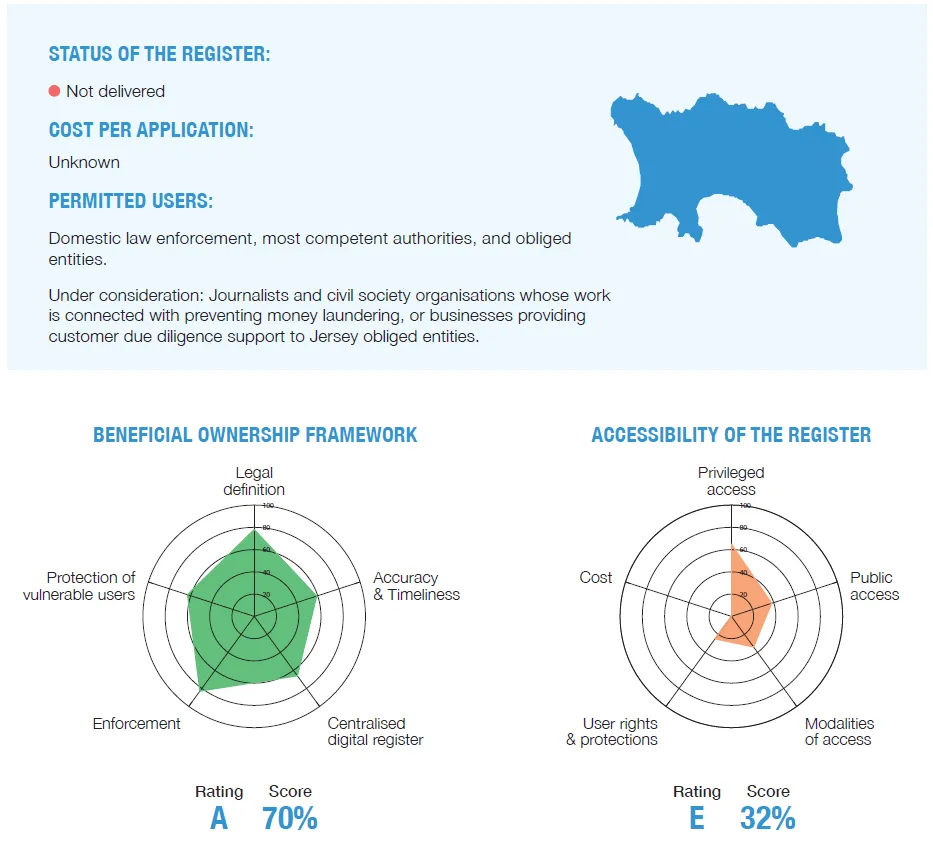
Background
The largest of the Channel Islands, Jersey is home to just over 100,000 people
Its finance, legal and accounting sector represented 44 per cent of the local economy in 2025,
The registry team at the Jersey Financial Services Commission (JFSC) has sanction powers and carries out checks on companies but largely relies on TCSPs to police compliance for trusts. During 2025, the JFSC team inspected a total of 3,149 entities, mainly chosen due to high-risk factors rather than specific intelligence received.
Risks and vulnerabilities
Key risks
The use of complex corporate networks involving Jersey entities and discretionary trusts to launder the proceeds of foreign criminality, with underlying offences including corruption, drug trafficking, fraud and tax evasion.
The highest risk sectors for money laundering are banking, TCSPs, and fund management.
Vulnerabilities
Financial institutions could have stronger internal controls against money laundering, including group-wide safeguards against tipping-off offences.
There is also room for improving its supervision of firms, use of intelligence, criminal law enforcement, and confiscation powers to deprive criminals of their ill-gotten gains.
FATF status
Jersey is largely compliant with recommendations 24 and 25 – and deemed to be substantially effective in its oversight of legal persons and legal arrangements.
Overall, it is compliant with 23 recommendations; largely compliant with 16; and partially compliant with one.
Key strengths
Discrepancy reporting: Streamlined register access to support discrepancy reporting by obliged entities.
Key weaknesses
Location of applicants: Proposing to limit legitimate interest applications to those from the UK and Crown Dependencies.
Responsibility for data accuracy: Unlike Guernsey and the Isle of Man, Jersey puts all responsibility for identifying beneficial owners on the legal entity and its nominated officer, with fewer powers to compel information from suspected beneficial owners.
Reporting requirements: Beneficial ownership disclosures do not need to include all of a beneficial owner’s nationalities, the nature and extent of their ownership or control, or when they became or ceased to be a beneficial owner.
Case study: Singaporean money laundering gang
In 2023, Singaporean police arrested 10 people in connection with the country’s largest-ever money laundering operation, which is now thought to have involved over £1.8 billion in criminal funds. Law enforcement agencies allege the money derived from illegal sources overseas, including scams and unlawful online gambling.9 Singaporean authorities have seized at least £578 million worth of assets so far, and are in the process of auctioning some of them.10 Yet this is only part of the picture.
Working with the Organized Crime and Corruption Reporting Project and Radio Free Asia, we uncovered 123 UK properties worth over £208 million owned by those connected to this money laundering scheme. While most of these are residential apartments held by UK companies, the most expensive is £43 million of commercial real estate in central London’s Oxford Circus bought by a Jersey company, New Yihao Limited, at the end of 2021.11 According to filings on UK Companies House, one of the entity’s owners is Su Haijin,12 who was convicted in Singapore for resisting arrest and money laundering in 2024.13
Although originally from China,14 Mr Su has also reportedly held Cambodian15 and Cypriot citizenships.16 Just over a year before the purchase, Cyprus shut down its citizenship-by-investment scheme over money laundering concerns and amid questions about the robustness of due diligence checks on applicants.17
Jersey business service provider Fiduchi Group helped set up the New Yihao Limited structure, including a trust controlling it, just before the property purchase. This was after the money laundering risks associated with those buying Cypriot citizenship, including Mr Su, had become well known.18 Fiduchi Group continues to provide trustee services for Mr Su and his family despite his conviction. This raises serious questions about the quality of due diligence it performed on Mr Su.
Fiduchi Group states it has fully complied with all relevant laws and regulations, and that it would be wrong to suggest otherwise. Their spokesperson said the Group remains committed to maintaining high standards of professional conduct, and complying with their regulatory responsibilities. Fiduchi Group has not been subject to sanction by Jersey’s financial regulator or courts for anti-money laundering deficiencies.
In November 2026, the NCA and Su Haijin entered into a settlement agreement whereby Mr Su will forfeit 75 per cent of his assets frozen by the courts, including the two Oxford Street properties, £2.6 million in rental income, and £300,000 from a bank account.19
How Jersey can improve its beneficial ownership framework and accessibility
- Location of applicants: Do not limit access rights to only those from particular jurisdictions. In a world in which financial crime is increasingly globalised, it makes little sense for the response to be regionalised and siloed.
- Responsibility for data accuracy: Jersey should broaden the range of actors responsible for ensuring the accuracy of beneficial ownership information, including beneficial owners themselves.
- Reporting requirements: Jersey should broaden the range of information it collects and discloses on beneficial owners so users have a better understanding of who they are and how they own or control an entity.
Conclusion
Beneficial ownership disclosure has been a key plank of the UK’s approach to tackling illicit finance over the past decade, with notable success. Hundreds of millions of pounds worth of suspect assets have been identified, frozen, and investigated since the UK launched its world-leading corporate transparency regime a decade ago. But despite this progress, and the increasing utility of this data for identifying national security threats, enforcing sanctions, and promoting open and trusted markets, most of the UK’s offshore financial centres have been too slow to follow suit.
The Crown Dependencies have all pledged to make this data public at one point, only to drag their heels on implementation and then row back after a legal challenge in the EU – a judgment that does not directly apply to them. Almost four years on from the Sovim case
Using available laws, policies, and engagement with these governments, we have benchmarked how they compare to good practice standards for disclosing key company data to those with a ‘legitimate interest’, which largely reflect the EU’s sixth anti-money laundering directive. Given that the Crown Dependencies have explicitly stated their intent to follow developments in the EU, one would expect them to score well. However, our research shows they still have a long way to go, with their approaches more similar to those in the British Virgin Islands and Cayman Islands than to those in mainland Europe.
While constitutionally UK ministers may be constrained in what they can impose on the Crown Dependencies, more could be done to incentivise them to deliver progress at a faster pace. Governments in these jurisdictions should also up their game and do more to follow Europe’s approach to legitimate interest access instead of that of the BVI and the Cayman Islands. Fundamentally, the biggest barrier to progress is political will, not legal risk.
In an increasingly uncertain and insecure world, it is imperative that those who can help tackle these threats – from transnational organised crime to kleptocracy and arms trafficking – have the means to do their bit. This requires far more access rights to corporate ownership data in these offshore financial centres than is currently planned, especially for journalists and NGOs investigating these crimes.
Methodology
Our assessment is based on the rating of 92 criteria, set out in our blueprint published in September 2025.
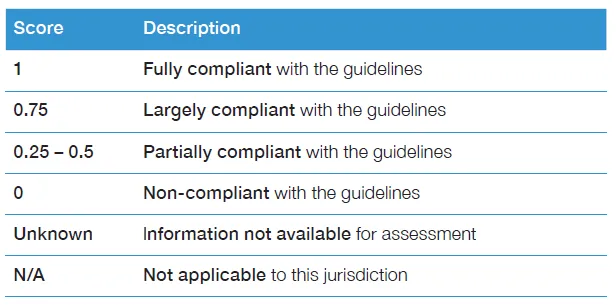
These individual scores are then aggregated into two totals measuring the robustness of the jurisdiction’s beneficial ownership framework and the accessibility of the register. These totals are then banded on a scale of A – F (see Table 2). More details on the constituent parts of these totals are provided below.

Beneficial Ownership Framework
Legal definition assesses how beneficial owners are defined in law, including whether the definition covers all relevant legal entities, whether thresholds are appropriate, and whether any exemptions are narrowly tailored and justified.
Accuracy & timeliness examines the obligations placed on beneficial owners and legal entities to submit accurate information and to update it promptly when changes occur. It also looks at whether appropriate checks are performed to ensure data quality.
Centralised, digital data evaluates whether beneficial ownership information is held in a central register that is digital, machine-readable and searchable. This includes considerations such as unique identifiers, auditability of the data and overall usability.
Enforcement considers the availability and proportionality of both administrative and criminal sanctions for non-compliance. This includes sanctions for legal entities, directors, beneficial owners, and any third parties responsible for filings.
Protection of vulnerable users assesses whether the framework includes narrowly defined provisions to protect individuals who face a well-evidenced and exceptional risk of harm if their beneficial ownership information is disclosed. It also includes requirements around transparency.
Accessibility of the Register
Privileged access looks at the level of access granted to law enforcement agencies, competent authorities, and obliged entities (e.g., financial institutions) regulated for anti-money laundering.
Public access examines what information is available to the public and under what conditions. Criteria vary depending on whether the jurisdiction has committed to adopting a public access register or a legitimate interest register.
Modalities of access (legitimate interest models only) assesses how users can demonstrate legitimate interest, the clarity of the criteria, the efficiency of the process, and whether access is timely and not overly burdensome.
Cost evaluates whether access costs, if any, are reasonable and proportionate for different types of users, including for commercial and non-commercial use.
User rights & protections considers whether users are free to reuse and analyse the data they obtain and whether their identity is protected, particularly in systems where users must apply or register to access information.