
Date of publication
30 September 2025
Reading Time
4 minutes
Current affairs offer few anniversaries worth celebrating, but many to lament. This February marked three years since Russia launched its brutal imperialist invasion of Ukraine, sparking a conflict on a scale not seen in Europe since the Second World War. While Ukraine’s stiff resistance continues to frustrate what was supposed to be one of the world’s mightiest armies, the price of this unprovoked and illegal aggression will weigh heavily on generations to come. With still no end in sight, its heroism is now measured in days and lives lost.
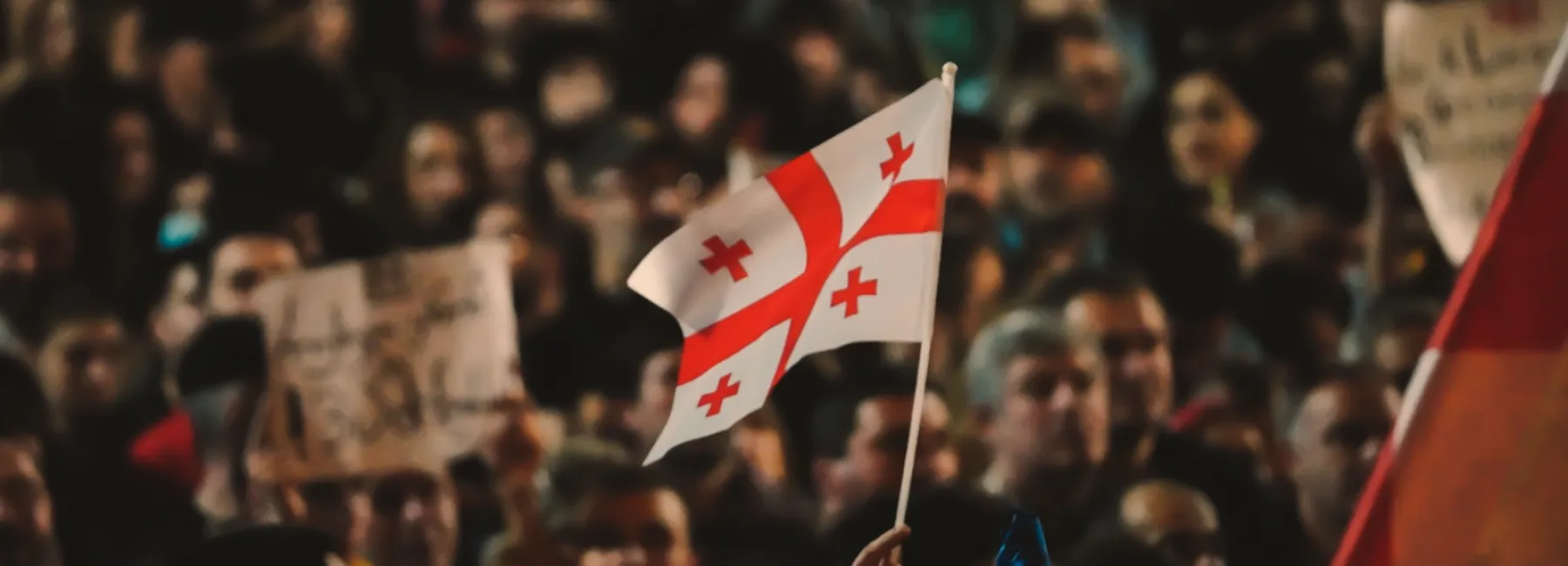
This new Cold War has reached the South Caucuses, too, bringing its own grim milestones. Last week saw the 300th day of public protests in Georgia’s capital, Tbilisi, as ordinary citizens resist a creeping authoritarianism and the systematic dismantling of democracy. Despite police brutality, state harassment and anti-protest propaganda from government-aligned media channels, Georgians continue to fill the streets.
While their country has so far avoided the widespread bloodshed that has engulfed Ukraine, there is a slow and progressive crushing of civil society and independent media, as a new iron curtain descends. The catalyst was the Georgian government’s decision to pause efforts to seek accession to the European Union – a move preceded by allegations of electoral fraud and a growing shift amongst the ruling Georgian Dream party towards Russia.
Despite this, the West’s response has been too timid and too slow. This must now change.
Real power in Georgia lies with Bidzina Ivanishvili – the country’s former Prime Minister, founder of the Georgian Dream party, and the grey cardinal controlling the current regime from behind the scenes. Any meaningful Western response must be judged on how it might influence his behaviour.
In September 2023, before the current protests began, the US sanctioned Ivanishvili’s former associate and prosecutor, Otar Partskhaladze, as part of broader Russia-based sanctions. Almost exactly two years later, the UK followed suit. While possibly symbolic, these moves may have been counterproductive - Partskhaladze and Ivanishvili have fallen out, so these decisions may benefit Georgia’s hidden ruler rather deter him.
In December 2024, as a swan song from the Biden administration, the US sanctioned Ivanishvili himself for actions that have ‘eroded democratic institutions, enabled human rights abuses, and curbed the exercise of fundamental freedoms in Georgia.’ Though this designation followed similar restrictions imposed by Ukraine, and visa bans imposed by Lithuania and Estonia, both the EU and UK have failed to do the same, with the latter focussing instead on police involved directly in repression.
It should now be patently clear that setting the UK’s sights on lower order officials, many of whom will never set foot in the UK, is being interpreted as posturing rather than pressure – leaving Georgia to fall further into autocracy and Russia’s grip. If sanctions are to be more than a paper tiger it’s time they bit those higher up the food chain.
Given Ivanishvili’s enormous wealth, critics of high-level sanctions argue that targeting him directly risks collapsing the Georgian economy, throwing the country into crisis and damaging the livelihoods of those desperate to build stronger relations with the West. Yet, previous US action demolishes this argument - they have hit the man without collateral damage against ordinary Georgians.
There is also a fundamental perversity in the logic that an oligarch’s wealth should make them too big to challenge. This reasoning effectively rewards the accumulation of power and wealth, undermining to the very foundations of the UK’s global campaign against corruption. In doing so it sends a dangerous message – control enough and you become untouchable.
Given the current pace of action from the UK, and seeming indifference from a distracted US, Georgia’s slow and crushing descent into authoritarianism remains unchallenged by its supposed allies. A ministerial reshuffle in Whitehall hasn’t helped, though this pattern of inaction spans several years. The lesson to learn from recent events is clear - hesitation emboldens strongmen.
Without greater urgency from the UK and its allies, we will soon find ourselves marking not 300 days of protests, but the death of Georgia’s democracy itself.