
Date of publication
10 February 2026
The UK has dropped to its lowest ever score in Transparency International's Corruption Perceptions Index (CPI).
Results published today show the UK's score has fallen to 70, down from 71 last year. This marks the UK's lowest point since the Index underwent a major revamp in 2012. The UK remains 20th in the global ranking for the third consecutive year, a significant decline from its top ten position back in 2017.
The results come as the government finds itself mired in scandal over the relationship between former Ambassador Peter Mandelson and convicted sex offender Jeffrey Epstein, with police now investigating Mandelson for misconduct in public office over alleged leaks of sensitive government information. Transparency International UK have warned that this kind of scandal does huge damage to public trust and increases concerns around corruption in government.
This year’s score of 70—which comes despite recent commitments to restore integrity in politics—shows that business as usual is not enough to turn the corner, with corruption concerns risking becoming embedded as the 'new normal'.
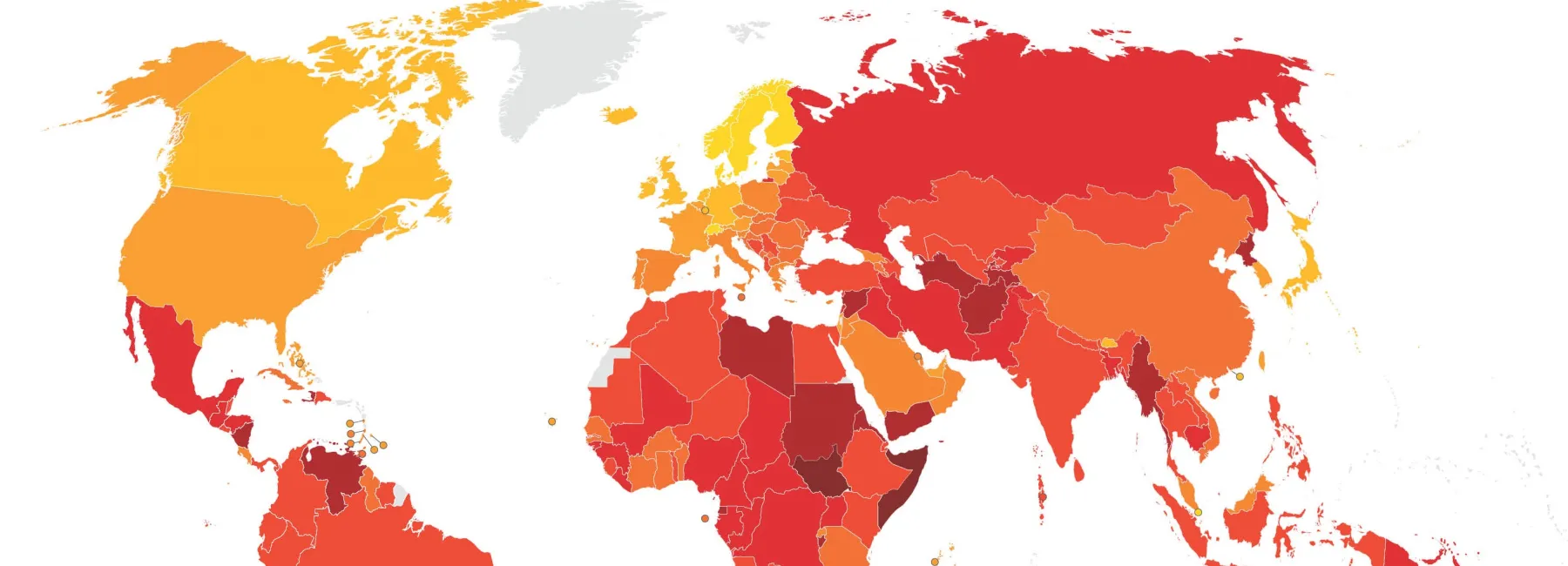
The CPI uses impartial surveys from experts and business leaders to score and rank countries by the perceived level of corruption in their public sectors. The result is presented on a scale of zero (perceived as highly corrupt) to 100 (perceived as very clean).
The UK's 2025 CPI score demonstrates the continuing challenge facing the country's reputation for good governance. This year's Economist Intelligence Unit expert assessment downgraded the UK's score for corruption in government and public office. The data shows there are no grounds for complacency and that perceptions of corruption in politics and the public sector will not inevitably bounce back at some point.
Daniel Bruce, Chief Executive, Transparency International UK said:
"For three years running, the UK has been stuck at 20th place in the Corruption Perceptions Index with a score that continues to deteriorate. This persistent decline is not a temporary blip - it risks becoming a defining feature of our political culture.
"The data collection period for this year's index covers some of the highest spending political campaigning on record, alongside troubling reports of access-for-cash arrangements and questionable appointments processes. Unless we act decisively to tackle the corrupting influence of big money in politics and strengthen anti-corruption frameworks, these concerns will become the new normal.
"The UK government must demonstrate that it is serious about restoring integrity. That means taking bold action to remove big money from politics, delivering genuinely open government, and ending the cronyism that undermines public trust in our institutions."
The UK's latest score is based on data from eight independent sources, six of which contain new data. All sources consulted experts and business executives for their views on abuses of public office for private gain and bribery in the UK.
New data for this year's CPI were collected between January 2024 and September 2025, during which time:
- parties spent record amounts on election campaigning supercharging a reliance on wealthy backers, with the Conservatives accepting £15 million from a single donor in less than 12 months, and Elon Musk reportedly considering a $100 million (£85 million) donation to Reform UK
- media outlets reporting that a Labour donor had received a privileged pass to Number 10 Downing Street, and that the Labour Party, lobbyists and parliamentarians were soliciting cash in return for privileged political access
- allegations that the Government had made several appointments to donors without following due process
Two of the CPI 2025 sources saw an increase in the UK's score compared to previous years, while two decreased, reflecting mixed expert and business perceptions of corruption in the UK.
The UK can restore its reputation and regain its place in the CPI's top 10. Transparency International UK calls on the government to:
- Protect democracy by removing the corrosive influence of big money in politics: place a meaningful cap on donations; reduce campaign spending limits; increase transparency over the source of funds entering politics; and strengthen the Electoral Commission.
- Deliver open government: extend transparency requirements to all lobbyists, and require more detail about these interactions, including the form and date of communications, what the lobbyists are trying to influence, and specific ministers/officials targeted, as is the case in countries like Canada, Germany and the US.
- End cronyism and corruption in Parliament: end corruption-prone practices that bring our legislature into disrepute, including MPs holding second jobs, and reforming the process for making appointments to the Lords and removing those found engaged in serious misconduct.
Corruption around the World
Globally, the CPI average score has dropped to 42, its lowest level in more than a decade, pointing to a concerning downward trend. The vast majority of countries are failing to keep corruption under control: more than two-thirds - 122 out of 180 - score under 50.
Data show that democracies, typically stronger on anti-corruption than autocracies or flawed democracies, are experiencing a worrying decline in performance. This trend spans countries such as the United States (64), Canada (75) and New Zealand (81), to various parts of Europe, like France (66), Sweden (80) and the UK itself.
For the eighth year in a row, Denmark received the highest score on the index (89) and is closely followed by Finland (88) and Singapore (84).
Since 2012, 50 countries have seen their scores significantly decline in the index: those which dropped the most include Türkiye (31), Hungary (40) and Nicaragua (14). They reflect a decade-long, structural weakening of integrity mechanisms, fuelled by democratic backsliding, conflict, institutional fragility, and entrenched patronage networks
Contact:
Jon Narcross, Senior Media and Communication Manager
[email protected]
+44 (0)20 3096 7695
+44 (0)79 6456 0340 (out of hours)