
Date of publication
30 July 2025
In late July, the Government published its long awaited National Money Laundering Risk Assessment (NRA), marking the first update since 2020. This report provides insights into the evolving money laundering threats the UK faces, which requires a joint-up response from Government departments, regulators, the private sector and civil society.
Below we take a closer look at the themes of the NRA, how they complement our previous work, and look ahead at what needs to be done to face these challenges.
Opaque property ownership
Property remains a key area of concern with the National Crime Agency estimating there is a realistic possibility that up to £10 billion could be laundered through the UK property market each year. The use of complex structures to own property is a key enabler, making it easier to hide suspicious owners and their sources of wealth.
Historically, secretive shell companies have been the key obstacle to revealing property ownership, however with the introduction of the Register of Overseas Entities (ROE), this has shifted the attention to opaque trusts. The NRA highlights our research released earlier this year, which identified more than 170 properties – worth £2.5 billion – bought with suspicious wealth and owned using opaque trust structures.
The NRA also notes potential risks related to other opaque financial products – such as collective investment trusts, Real Estate Investment Trusts (REIT) and Open-ended Investment Companies (OEIC) – where money is pooled with dividends paid out annually. The UK Government is yet to quantify the scale of risk related to these vehicles, though their concerns echo our analysis of the ROE in 2022.
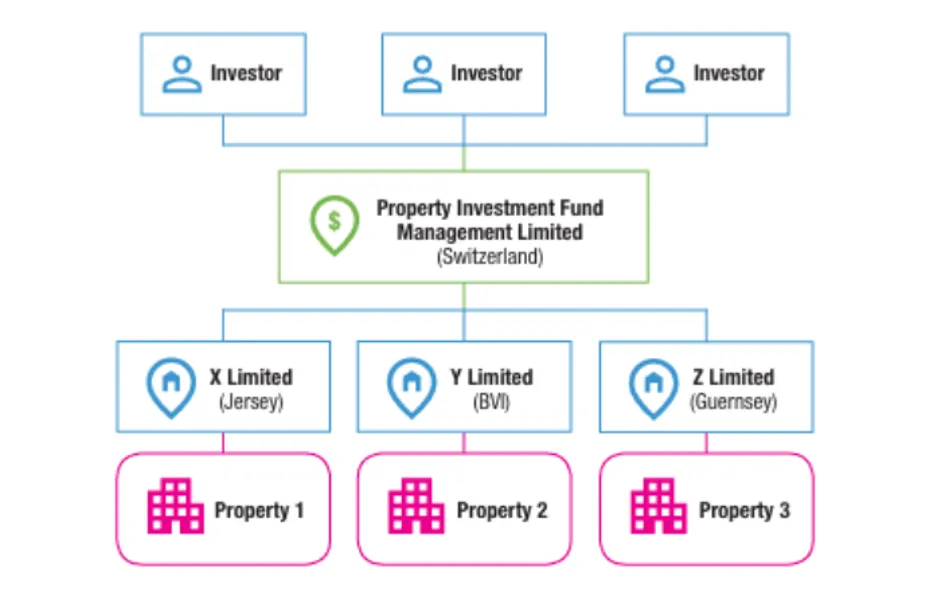
Example of opaque property investment fund
Alternative payments and tech
Since the 2020 NRA, we have seen growing evidence that criminals are using a broader array of methods outside the traditional banking sector to move illicit wealth around the world. The 2025 NRA recognises this trend, offering a detailed account of the emerging techniques used by criminals to move their ill-gotten gains.
The increasing size, complexity and geographical spread of alternative payment firms – such as electronic money businesses and payment service providers – has moved this sector’s risk profile from medium to high-risk. This reinforces our 2022 research, which found more than one in three UK-registered electronic money institutions (EMIs) had money laundering red flags relating to their owners, directors or activities.
Government’s assessment of money laundering risk related to cryptocurrency service providers and cryptocurrency has also increased due to the anonymity, speed, and global reach of transactions within the sector. It notes jurisdictions of risk, including Russia, where research by our colleagues in exile has found a flourishing market for informal crypto-to-cash payment services, including money mule accounts.
Outside of the regulated sector, the NRA gives a breakdown of different ‘Informal value transfer systems’ (IVTSs) used around the world to launder money, including underground banking, Hawala and Hundi. These systems exist outside of the formal banking system and operate in a largely unregulated fashion, relying on a trust-based network of operators around the world.
Together, these alternative payment mechanisms pose an evolving threat that the UK and its global partners must develop an effective response to.
Professional Enablers
Across-cutting theme throughout the assessment which increases the UK’s vulnerability to dirty money is that of ‘professional enablers’.The NRA defines these as: “an individual or organisation that is providing professional services that enables criminality. Their behaviour is deliberate, reckless, improper, dishonest and/or negligent through a failure to meet their professional and regulatory obligations”.
The vulnerability of professional enablers, and the risk that they might intentionally or unintentionally enable financial crime is exacerbated by the fact that they are poorly regulated. In particular, the fragmented nature of supervision for lawyers and accountants (with over 22 bodies in charge of overseeing their anti-money laundering compliance) has been a longstanding issue. The powers and resources available to these bodies vary considerably, whilst enforcement action does not provide a credible deterrent against poor anti-money laundering procedures or willful blindness. The assessment underscores the need for reform, echoing demands from both civil society and the private sector to consolidate anti-money laundering oversight in the non-financial sector.
Facing up to the threat
As those involved in criminality and corruption continually seek new ways to circumvent rules, the Government should take the following steps to ensure the UK is well equipped to deal with this threat:
Tackle trust opacity
On the same day as the NRA was published, the Government also responded to the 2024 consultation on improving the Money Laundering Regulations (MLRs), committing to bringing greater transparency to overseas trusts holding property in the UK. These reforms are welcome and should be introduced as soon as possible, alongside a reformed ‘legitimate interest’ system which enables those involved in tackling money laundering to have direct, open access to all ownership information of trusts.
Build momentum at the 2026 Illicit Finance summit
In 2026, the UK will host a summit on illicit finance, which will see countries from around the world represented in seeking to tackle this issue. This should be used as an opportunity to build consensus on how to address the risk of transnational money laundering by alternative payments.
Overhaul the supervision of the private sector
The Government should follow through on its ambition to reform anti-money laundering supervision. This should be achieved through consolidating the number of AML, well-resourced statutory supervisor for the non-banking sectors, providing a consistent and effective response to the threat of dirty money.
These changes would significantly improve the UK’s response to the various risks outlined in the NRA. The risks are now well understood, the onus now lies with the UK Government, regulators and private sector to end the UK’s role as a hub for dirty money.