Read more

AI-related lobbying engagements with UK Government ministers, Scottish Government ministers and MSPs rose from 42 in 2022 to almost 500 in 2025, according to our analysis of official transparency data. If the current trend holds, AI-related lobbying will have increased 15-fold between January 2022 and the end of 2026.
The real figure is almost certainly higher. Much of the industry's lobbying activity never reaches the public record, because gaps in the disclosure rules in Westminster and Scotland keep political access and potential influence behind closed doors.
That should concern everyone, not just those who follow lobbying closely. Decisions about AI will shape energy bills, local environments and jobs, and the public have a right to know who is shaping them. Both governments should close the loopholes that stop them finding out.
Using official transparency data, we identified every AI-related meeting with UK ministers, Scottish ministers and MSPs since 2012. The growth is striking enough on its own, but the data also points to a marked imbalance in whose voices reach decision-makers, in both the UK and Scotland.
Of the 103 AI-related lobbying meetings with Scottish ministers and MSPs reported since 2022, almost two thirds (63%) advocated for greater use of AI or for expanding the infrastructure – such as data centres – needed to deploy it. Fewer than one in ten (9%) discussed the risks associated with the technology. The remainder were neutral.
This matters. When ministers mostly hear from those who stand to benefit from AI, their understanding of the risks is likely to be skewed. Local communities and workers will live with the consequences of these decisions and should have a voice alongside industry. Without a wider range of views, policy risks serving vested interests rather than the public good.
Other research on the lobbying of UK ministers has found a similar picture. In October, Spotlight on Corruption found that 79% of organisations lobbying the UK Government on data centres between July 2024 and June 2026 were businesses. No environmental organisations, and only two community groups, were recorded as having met ministers.
UK Government data, which covers engagements up to late June 2026, shows AI-related meetings concentrated in four departments: the Department for Science, Innovation and Technology, the Department for Business and Trade, the Department for Culture, Media and Sport, and the Treasury.
These figures capture only part of the picture. Loopholes in the disclosure rules in Westminster and Scotland mean a great deal of lobbying activity is never recorded.
In Westminster, the statutory register of lobbyists covers only those lobbying on behalf of paying clients. 'In-house' lobbyists employed directly by businesses, trade unions or large charities are excluded altogether. Our research has found that, at most, 4 per cent of the organisations appearing in departmental transparency releases are on the statutory register.
UK ministers are also under no obligation to report contact with lobbyists via WhatsApp, impromptu phone calls or email, despite these channels featuring regularly in recent scandals. This week, the Guardian reported that the US tech company Palantir had lobbied the former health minister Zubir Ahmed over WhatsApp to consider applying its software to GP records. That exchange only came to light after an NGO requested it under the Freedom of Information Act.
Special advisers are not required to declare their interactions with lobbyists either. In May, the Guardian reported that the Prime Minister's key business aide had held 16 undisclosed meetings with major US tech companies. None of these appear in our analysis.
In Scotland, the so-called 'zoom loophole' means that a video call with a lobbyist must be declared, but the same call with the camera switched off need not be. This leaves Scotland notably out of step with other major democracies, including Ireland, Canada, the US and the rest of the UK. Meetings with senior civil servants fall outside the regulations entirely, and lobbying only has to be disclosed every six months – long enough for major decisions to be taken before the public can see who policy-makers have been speaking to.
AI is a key driver of the growth of 'hyperscale' data centres in Scotland, where proposals to build up to 23 of these facilities – including one that could rank among the largest in the world – have met growing opposition from local communities.
Campaigners have accused the Scottish Government and MSPs of failing to give those communities a proper hearing on the environmental and social impacts of these developments. According to the NGO Action to Protect Rural Scotland (APRS), Scottish ministers declined at least eight requests from community groups for meetings to discuss their concerns in 2026. Penny Sinclair, from the community organisation Auchtertool Action Group, has argued that:
"Communities have been consistently shut out of any discussions whilst developers and tech companies have been given a front row seat at the government consultation table."
In September, MSPs voted to pause planning decisions on new hyperscale data centres in Scotland, at least until the Scottish Government publishes national planning guidance. Ministers are expected to publish that guidance before the end of the year. The coalition Stop Climate Chaos Scotland and other campaigners have criticised the Government for failing to consult the public on it, warning that it could prioritise the interests of tech companies over those of local communities. Patrick Harvie MSP said:
"By refusing to carry out a robust public consultation ahead of issuing guidance, it seems that the loudest voices we can expect to hear will be the vested interests in the tech industry waiting to profit."
A key point of contention is how the guidance defines a sustainable, or 'green', data centre. Emails obtained under freedom of information laws show that in May, Scottish Government officials considered an industry-produced definition, although they ultimately decided not to endorse it.
More than 15 NGOs, including APRS and Friends of the Earth Scotland, are planning a march on Saturday to call for greater public involvement in decisions on hyperscale data centres.
The debate is not confined to Scotland. Hyperscale data centres were a prominent issue in the US midterm elections, in which AI investors spent well over $100 million. Some 41% of planned capacity in the US now sits in states where governors have committed to pausing new developments.
The same pattern runs to the top of the UK Government. As Prime Minister, Sir Keir Starmer pledged to "mainline AI into the veins" of the UK, and during his tenure almost one in ten of his external engagements were focused on AI.
Our analysis adds to wider concerns that ministers have prioritised engagement with major tech firms at the expense of other groups affected by the technology. In January, the Guardian reported that between October 2023 and October 2025, tech firms had three times greater access to UK ministers than organisations campaigning against the use of artists' copyrighted work to train AI models. In March, the government backtracked on its preferred plan to allow AI training on copyrighted work with an opt-out for artists. It has yet to set out a new position.
Two things need to happen.
First, lobbying needs to come out of the shadows. Weak written rules mean too much industry influence takes place out of public view, and the remedies are well understood. The UK Government's own ethics watchdog has already set out what is needed: a more comprehensive lobbying register that includes lobbyists’ engagement with special advisers and senior civil servants, hosted on a single platform alongside departmental transparency releases; disclosure of ministers' informal contact with outside organisations, including over WhatsApp; meaningful detail on who is lobbying, on whose behalf, about what, and who stands to benefit; and more frequent, more timely publication. The Government should act on those recommendations.
In Scotland, ministers should publish more meaningful descriptions of their meetings, including the specific policy areas discussed, and require that they are published sooner. The Scottish Parliament should act on the findings of its own 2021 post-legislative review of the Lobbying (Scotland) Act 2016, which asked whether verbal communication such as phone calls should count as regulated lobbying, whether lobbyists should report what they spend, and whether senior civil servants should be covered by the rules, and called for lobbying to be reported every three months rather than every six.
Second, governments need to listen to the people who will be affected by decisions on AI. Artists, workers and communities facing hyperscale data centres on their doorstep will live with the consequences of these policies long after the meetings that shaped them have been forgotten. Substantive engagement with those groups is the surest guard against the perception, or the reality, that AI policy has been captured by the industry it is meant to govern.
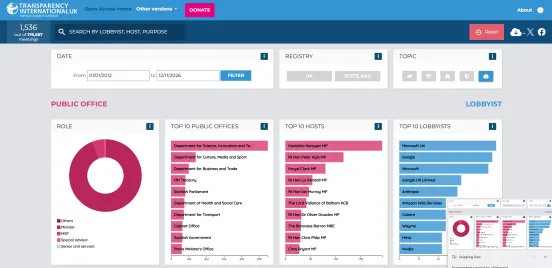
The analysis draws on UK Government transparency disclosures and the Scottish statutory register of lobbyists. Alongside it, we are launching a new tool so that anyone can track AI lobbying across the UK and Scotland for themselves.
Part of our Open Access platform, it allows journalists, researchers and members of the public to view every AI-related meeting with UK Government ministers, Scottish Government ministers and MSPs from 2012 onwards, and to search the data by organisation, minister or date. To see AI-related meetings, select the 'AI' icon in the Topic filter at the top right of the page.
To categorise the meetings, we use an open-weights AI-based large language model to categorise each meeting automatically, based on its description, hosts and lobbyists. Whenever new meeting data is released, the model sorts through it and assigns each meeting to one of five categories: Health, Housing, Defence, Climate and AI.
What the tool shows is the lobbying that governments have chosen to record. The meetings held over WhatsApp, the calls with the camera off and the conversations with special advisers are not there, because the rules do not require them to be. Until that changes, the public will only ever see part of who is influencing the decisions that will shape their lives.